Preventive healthcare startup Cent raises $15 million to advance early disease detection and health monitoring
Three points you will get to know in this article:
- How Cent plans to use its $15 million Series A funding to bolster preventive healthcare.
- How medical imaging and diagnostics powered by AI might help detect potential health risks at an earlier stage.
- Why Cent bought Medsee and intends to complete 10 million scans by 2035.
Cent secures $15 million to grow its AI-driven diagnostics, early disease detection, medical imaging, and preventive health monitoring.
Cent Secures $15 Million to Grow Preventive Healthcare
Cent, a preventive health startup headquartered in Bengaluru, has secured $15 million in a Series A funding round that was co-led by Blume Ventures and existing backer South Park Commons. The round comprises both equity and debt, and several individual investors also took part.
Among the investors are former Vodafone CEO Arun Sarin, former OpenAI business-to-business CTO Srinivas Narayanan, Sharath Narayana, Krishna Sridhar and Aprameya Radhakrishna.
Cent intends to use the new capital to broaden its research and development (R&D), bolster its artificial intelligence (AI) capabilities and expand its clinical and engineering teams. Its aim is to make preventive healthcare more accessible by spotting potential health issues before symptoms emerge.
In addition, the company brings together medical imaging, diagnostics, AI and bioinformatics within a single healthcare platform. This approach is designed to give doctors a wider view of an individual’s health and to help them spot findings that may call for further investigation.
The fundraise also coincides with Cent’s acquisition of Medsee, an AI-driven radiology reporting platform. Combined, these developments back the startup’s ambition to build a technology-driven preventive healthcare business in India.
Who Established Cent?
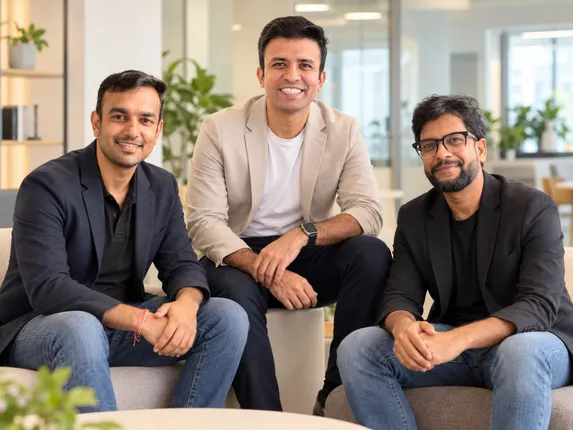
Cent was established in 2025 by three entrepreneurs who bring experience in healthcare technology, consumer businesses and product development.
- Shashank ND: Founder of Practo and OneFlow Holdings.
- Anshul Khandelwal: Former chief marketing officer at Ola Electric.
- Arpit Garg: Former head of product at Lenskart.
The founders aim to move healthcare away from treating illnesses once symptoms appear and toward spotting potential risks sooner. Their approach centers on pairing diagnostic technology with continuous health monitoring.
According to the company, this model could help people gain a more comprehensive understanding of their health and get medical guidance before certain conditions grow more serious. Yet screening cannot prevent or detect every disease, and results must be interpreted by qualified medical professionals.
How Cent Applies AI to Detect Diseases Early
Cent is building a preventive health platform that merges medical imaging, lab tests, and analysis supported by AI. The goal is to unify various health indicators instead of depending on one test or a separate report.
Medical Imaging Enhanced by AI
Medical imaging can assist doctors in detecting abnormalities that might not produce obvious symptoms. Cent employs AI-based radiology tools to assist with the analysis and reporting of imaging results.
This technology can help sort findings and highlight areas that need additional review. That said, AI assists the diagnostic process; licensed medical professionals are still accountable for interpreting results and making clinical decisions.
Merging Various Health Indicators
Cent also draws on bioinformatics and diagnostic data to build a more complete picture of a person’s health.
Through the analysis of multiple data types, the company seeks to create improved methods for spotting potential disease risks and monitoring changes over time. Over the longer term, Cent intends to leverage its expanding dataset to establish health baselines that are relevant to India’s population.
These capabilities remain contingent on suitable clinical validation, data quality and responsible usage. Their effectiveness will need to be evaluated via continued research and real-world outcomes.
What Exactly Is Cent Check?
Cent Check, the company’s flagship offering, combines multiple diagnostic procedures into one visit that takes about two hours.
As stated by the company, the assessment covers:
- Magnetic resonance imaging (MRI) of the entire body.
- Low-dose computed tomography (CT) scanning.
- Dual-energy X-ray absorptiometry (DEXA) for measuring bone density.
- Electrocardiography (ECG).
- Echocardiography (ECHO).
- Testing that spans over 100 biomarkers.
Cent’s proprietary protocol merges these results into a single, consolidated health assessment. Specialist physicians examine the findings, and members then receive a doctor-guided health plan along with follow-up support.
What Did Cent Report From Its First 10,000 Scans?
Cent states that it has now completed 10,000 preventive whole-body scans across Bengaluru, Mumbai and Delhi-NCR.
According to the company, one in four members who arrived feeling healthy had a finding that called for action, and one in 40 needed immediate medical attention. Findings reported included early-stage tumours, narrowed arteries and aneurysms.
These are results reported by the company; they do not prove that comprehensive screening benefits everyone. Screening can lead to false positives, unnecessary follow-up tests, or findings that have no effect on a person’s health. People should talk with a qualified doctor about the benefits, limitations and suitability of screening.
Even so, the results show why Cent is investing in early detection and integrated diagnostic services.
Cent Acquires Medsee to Bolster AI Radiology
In addition to revealing its funding, Cent has acquired Medsee, an AI-driven radiology reporting workflow platform established by Chitra Singh.
Medsee assists licensed medical professionals in drafting structured radiology reports and flags findings for radiologists to review. The platform is built to enable quicker, more consistent reporting as scan volumes rise.
What Makes This Acquisition Significant?
As Cent broadens its preventive health services, it will need to handle an increasing amount of imaging data and clinical reports.
Medsee’s technology may assist in streamlining certain parts of this process. It could also enable better coordination between imaging workflows and the physicians who interpret the results.
By adding a specialised reporting platform to its existing diagnostic operations, the acquisition enhances Cent’s technology offering.
Yet reporting efficiency on its own does not ensure diagnostic accuracy. When AI is used in healthcare, human review, clinical quality controls and proper validation remain essential.
How Cent Aims to Utilize Its $15 Million in Funding
Cent plans to direct the new capital into three primary areas.
1. Research & Development
The company intends to bolster R&D in medical imaging, diagnostics, and bioinformatics. This effort could enable it to enhance its technology and create new approaches for analysing health information.
2. Growing the AI and Engineering Teams
Cent will put resources into its AI and engineering capabilities so it can develop and scale its technology platform. These teams will assist in building systems capable of handling rising scan volumes and supporting diagnostic workflows.
3. Expanding Clinical Capabilities
In addition, the startup intends to grow its clinical team. This investment matters since preventive healthcare demands more than technology; it also calls for skilled professionals to review findings, communicate results and guide patients.
Taken together, these investments are intended to help Cent scale its services while keeping suitable clinical oversight in place.
Cent Sets Sights on 10 Million Scans by 2035
Cent has set an ambitious target of completing 10 million preventive scans by 2035. To achieve this goal, the company will need to broaden its services, strengthen operational capacity and establish a dependable system for managing diagnostic data.
The startup also aims to leverage its expanding dataset to create health baselines for people in India who may not exhibit symptoms of disease. In time, these insights could aid research into earlier risk detection and more personalised preventive care.
Yet scaling this model will present a number of challenges. Advanced imaging can be costly, diagnostic infrastructure demands substantial investment, and AI systems must be validated for clinical use.
Cent will also need to safeguard data privacy and security as it gathers and analyses sensitive health information.
Its long-term success will therefore hinge on more than the number of scans completed. Clinical quality, affordability, patient trust and measurable health outcomes will matter as well.
What Cent's Funding Could Mean for India's Preventive Healthcare Market
Cent’s $15 million fundraise points to rising investor interest in technology-driven healthcare services.
Conventional healthcare tends to concentrate on diagnosing and treating illness once symptoms have appeared. Preventive healthcare, in contrast, seeks to spot risk factors sooner and promote timely medical intervention.
AI can help enable this shift by assisting healthcare professionals in organising information, reviewing medical images and spotting findings that require further assessment.
Cent is going after this opportunity by combining diagnostic services, imaging technology, AI and clinical care. Its acquisition of Medsee further illustrates how specialised technology can be folded into a wider healthcare platform.
Even so, early detection has to go hand in hand with sound clinical decisions. Not every abnormal finding turns into a serious illness, and screening methods come with differing benefits and limitations.
For preventive healthcare startups, the task is to deliver services that are useful and accessible while upholding medical quality and winning public trust.
Cent’s $15 million Series A round represents a major milestone in its effort to grow AI-driven diagnostics and early disease detection across India. Backed by Blume Ventures and South Park Commons, the funding will go toward R&D, expanding the team and enhancing its healthcare technology.
With the acquisition of Medsee, the company’s platform now includes AI-assisted radiology reporting. At the same time, Cent Check brings together multiple diagnostic methods in one visit, with specialist doctors reviewing the results.
Going forward, Cent intends to complete 10 million scans by 2035 and leverage its expanding dataset to advance research on population-specific health risks.
In the end, Cent’s success will hinge on whether it can convert its technology and funding into preventive healthcare that is dependable, clinically valuable and widely accessible. The coming phase will reveal how well the company can scale while upholding diagnostic quality and preserving patient trust.

- Preventive healthcare startup Cent raises $15 million to advance early disease detection and health monitoring - October 28, 2026
- Snapdeal group’s Unicommerce adds 121 enterprise clients, posts Rs 6.4 crore profit in Q2 FY27 - October 26, 2026
- Mamaearth parent Honasa makes Vipul Maheshwari its CPTO to lead an agentic AI push - October 26, 2026