Pre-Revenue Deep-Tech & Hardware Startups Require Patient Capital & New Early-Stage Funding Mechanisms: Says FM
Three points you will get to know in this article:
- Why deep-tech startups that have not yet earned revenue require patient capital and fresh funding approaches.
- How IIT Madras is backing startups via funding and mentorship programs.
- How academia, industry, and government can collaborate to reinforce India’s technology ecosystem.
FM Nirmala Sitharaman emphasizes the importance of patient capital and fresh funding mechanisms for India’s deep-tech and hardware startups.
IITMAA Sangam 2026 centers on India's journey toward a self-reliant future
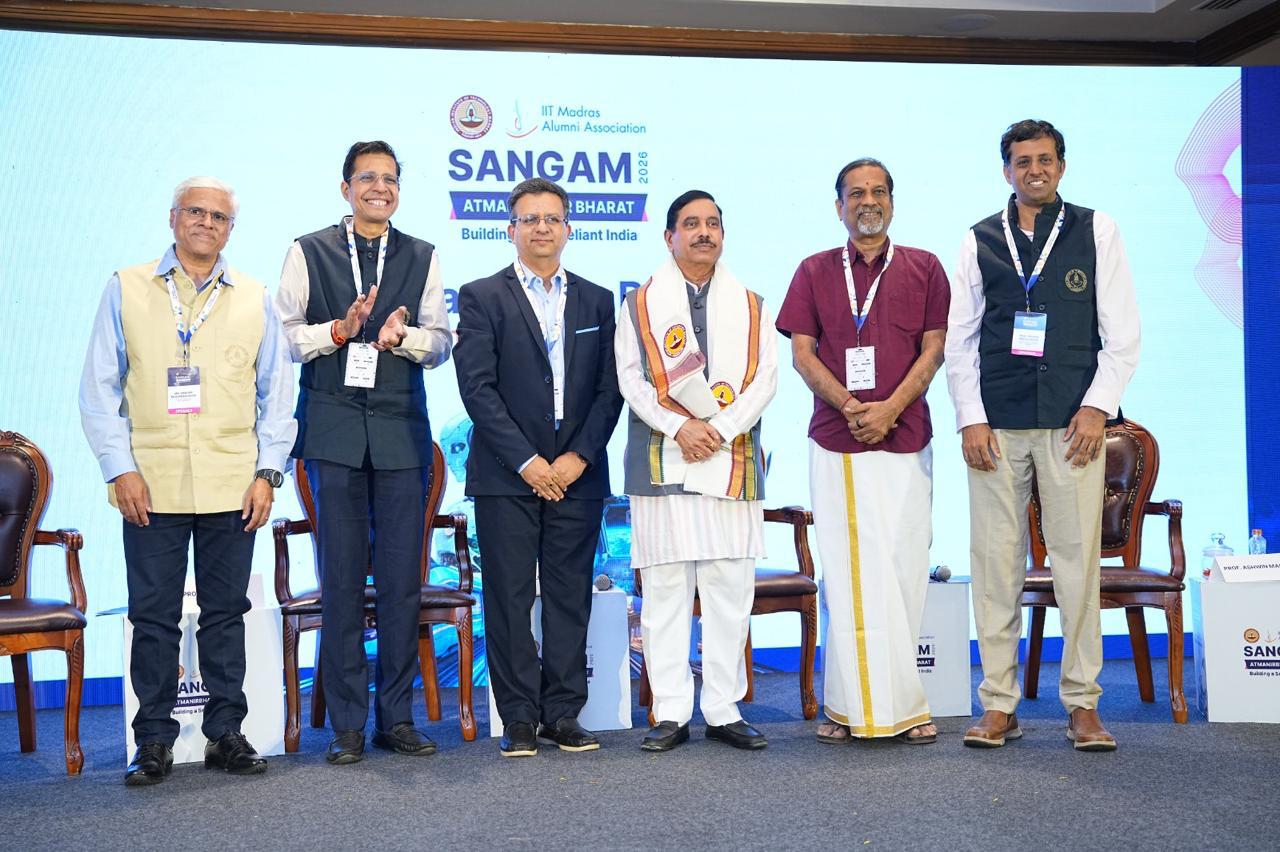
The 7th edition of IITMAA Sangam 2026 wrapped up on September 28, 2026, in Bengaluru. This yearly gathering of the IIT Madras Alumni Association assembled policymakers, industry leaders, technology experts, academics, entrepreneurs, and innovators.
Taking place at the Taj MG Road, Bengaluru, the event centered on “Atmanirbhar Bharat – Building a Self-Reliant India.” The summit examined the technologies, investments, and partnerships required to bolster India’s strategic and economic strength.
Major discussions addressed artificial intelligence, defence technology, space, semiconductors, digital financial infrastructure, and sustainable infrastructure.
FM Stresses the Importance of Patient Capital
Union Minister of Finance and Corporate Affairs Smt. Nirmala Sitharaman pointed to the funding difficulties confronting India’s budding technology firms.
As per the Minister, deep-tech and hardware startups that have yet to earn revenue need patient capital along with new mechanisms for early-stage funding. Such companies frequently require substantial investment before they start bringing in commercial revenue.
Deep-tech ventures also devote considerable time to developing research, prototypes, intellectual property, and scalable technologies. As a result, conventional funding models may not always be a good fit for their extended development cycles.
The Importance of Patient Capital
Patient capital allows businesses more time to develop and bring complex technologies to market. In contrast to funding models that prioritize quick returns, patient capital can sustain companies through extended research and development cycles.
This approach may be especially relevant for startups operating in fields such as:
- Artificial intelligence
- Semiconductors
- Defence technology
- Space technology
- Quantum computing
- Advanced manufacturing
- Clean energy
By enhancing access to appropriate early-stage funding, India can establish better conditions for deep-tech companies to grow and scale.
IIT Madras Program Aids Startup Expansion
Smt. Nirmala Sitharaman also noted an IIT Madras effort to establish a fund capable of supporting startups.
This initiative shows how academia, industry, and government can collaborate to reinforce India’s innovation ecosystem.
Collaboration of this kind can offer startups support that goes beyond funding. Entrepreneurs can also access research know-how, mentorship, technological infrastructure, industry connections, and market insights.
Bridging Academia and Industry
Universities hold a key position in deep-tech development, since a great deal of breakthrough technology begins in research institutions.
Partnerships with industry can subsequently assist in turning research into commercial goods and services. Meanwhile, government policies and funding mechanisms are able to foster an environment conducive to innovation.
This collaboration among the three parties can assist in closing the divide between research and commercialization.
India's Emphasis on Technology and Innovation
The summit underscored the increasing significance of technology in India’s economic growth.
Smt. Nirmala Sitharaman stressed that technology and innovation must extend to various sectors, such as agriculture, renewable energy, and advanced manufacturing.
She further identified AI, semiconductor chips, and quantum computing as fields that will demand substantial investment in India’s infrastructure.
Such technologies can boost productivity, enhance industrial capabilities, and generate fresh opportunities for Indian businesses.
IIT Madras Bolsters India's Startup Ecosystem
Education Minister Shri Pralhad Joshi pointed to IIT Madras as a prime example of India’s expanding innovation ecosystem.
As per the numbers presented at the event, IIT Madras is home to 560 startups, with 109 of them incubated during 2025–26. Together, these startups carry a valuation of roughly ₹80,000 crore, and the institute has also secured 472 patents along with ₹950 crore in alumni contributions.
Such figures illustrate the contribution academic institutions can make to nurturing startups, intellectual property, and technology-driven businesses.
Broadening Reach in Technology Education
Prof. V. Kamakoti, the Director of IIT Madras, likewise emphasized the institute’s initiatives to widen access to technology education.
Roughly 53,000 students have been reached by IIT Madras programmes, whereas NPTEL-SWAYAM courses cater to about 1.5 million learners.
Over the past three financial years, the institute has also filed more than 400 patents and incubated 583 startups, with a combined valuation of approximately ₹83,000 crore.
Notably, as per the figures shared at the event, about 75% of the startups incubated over the last two years originated from outside IIT Madras.
Deep Technology Tied to National Self-Reliance
The talks at IITMAA Sangam further linked deep-tech advancement to India’s wider self-reliance ambitions.
Dr. Sridhar Vembu, Chief Scientist and Co-founder of Zoho Corporation, stressed the strategic value of creating indigenous technologies.
He contended that heavy reliance on foreign technology platforms can give rise to economic and national-security weaknesses. He also stressed how important it is to develop domestic capabilities throughout the technology ecosystem.
The Significance of Indigenous Technology
Deep-tech innovation can assist India in building domestic capabilities in areas of strategic importance. These encompass defence, semiconductors, digital infrastructure, artificial intelligence, and advanced manufacturing.
Developing these capabilities can also open up opportunities for Indian startups to create products for domestic as well as global markets.
Emphasis was placed on AI, Defence, and Semiconductors
Across Sangam 2026, panel discussions and fireside sessions examined multiple strategic technology domains.
The discussions addressed:
- Sovereign artificial intelligence
- Advanced defence capabilities
- Maritime technology
- Semiconductor supply chains
- Digital infrastructure
- Sustainable energy
Participants from organizations such as Reliance Intelligence, Flipkart, NVIDIA, Texas Instruments, and Tata Electronics took part in discussions on these themes.
These conversations brought attention to the expanding link between technology innovation, industrial capacity, and economic development.
Creating a More Robust Entrepreneurial Ecosystem
At IITMAA Sangam 2026, mentorship and collaboration were also given strong emphasis.
Mr. Sridhar Boovaraghavan, President of IITMAA and Chair of Sangam 2026, underscored the growth of the Career and Life Coaching (CLIC) initiative.
The initiative is designed to link IIT Madras students with alumni mentors for guidance on personal, academic, and professional matters.
By assisting young entrepreneurs and students in making well-informed decisions, developing professional networks, and grasping industry requirements, mentorship can supplement funding.
The Function of Government, Industry, and Academia
The conversations held at Sangam 2026 highlighted how essential collaboration is.
Governments are able to establish enabling policies and funding structures. In parallel, academic institutions are capable of offering research capacity, skilled people, and intellectual property. Industry is able to supply capital, access to markets, commercial know-how, and technology partnerships.
By working together, these stakeholders can build a more robust environment for innovation.
Establishing Fresh Routes for Funding
For deep-tech startups that have yet to generate revenue, traditional venture capital might not always offer the most suitable form of support. Such companies frequently need extended timeframes to develop and bring their technologies to market.
As a result, novel early-stage funding models can help close the gap between research, prototyping, commercialization, and scaling.
These mechanisms can also motivate more entrepreneurs to take on ambitious technology ventures.
A Roadmap for Atmanirbhar Bharat
IITMAA Sangam 2026 offered a platform where stakeholders could discuss how technology might advance India’s self-reliance ambitions.
The emphasis on deep-tech funding, AI, semiconductors, defence, space, and advanced manufacturing highlights the increasing significance of domestic technology capabilities.
At the same time, the summit showed that self-reliance demands collaboration. Startups, universities, businesses, policymakers, investors, and professionals each have a part to play.
The message from IITMAA Sangam 2026 was unmistakable: achieving India’s deep-tech goals demands sustained investment, robust research capabilities, and cross-sector collaboration.
Smt. Nirmala Sitharaman’s focus on patient capital and new early-stage funding mechanisms for pre-revenue deep-tech and hardware startups underscores a significant funding challenge facing India’s innovation ecosystem.
At the same time, IIT Madras’ startup initiatives demonstrate how academia can partner with industry and government to support entrepreneurs.
As India advances on its path toward Atmanirbhar Bharat, stronger funding mechanisms, industry partnerships, mentorship, and technology development can help build an innovation ecosystem that is more resilient and globally competitive.

- Mobile gaming studio Spill Games raises $10.5 million in funding led by Elevation Capital - October 19, 2026
- Bengaluru spacetech startup OXG Space raises Rs 17 crore to build satellite connectivity network in orbit - October 19, 2026
- India’s top stock broker Groww accounts for 44% of new SIP registrations in India as mutual fund assets cross Rs 2 lakh crore - October 17, 2026