What Raj Shamani Asked That No One Else Ever Asked Deepinder Goyal
Three points you will get to know in this article:
1. Goyal revealed his use of a brain-monitoring wearable and his preference for text-based leadership due to a stammer.
2. The interview exposed the high turnover of 5,000 monthly gig workers and widespread customer/partner fraud addressed by a “Karma Score”.
3. Goyal admitted to being a difficult boss and provided blunt critiques of rivals like Swiggy and Zepto.
Things Raj Shamani Asked That No One Else Ever Asked Deepinder Goyal
One of the most talked-about interviews in the Indian startup scene is the recent edition of Raj Shamani’s “Figuring Out” podcast, which featured Deepinder Goyal, the founder and CEO of Zomato (now parent company Eternal). Raj Shamani’s questions, which are rarely probed by mainstream media, traditional journalists, or even business reporters, were what really set this episode apart.
Here, we analyze the unusual, audacious, and viral questions Raj Shamani posed to Goyal—questions that no one else had the courage to pose—as well as the subsequent disclosures.
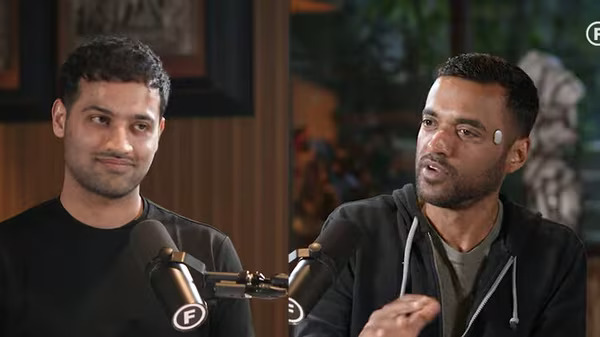
The Wearable Tech Curiosity: “What is That Thing on Your Temple?”
It wasn’t even a question about Zomato or company strategy that went viral during this interview; instead, it was about an enigmatic gadget that Goyal was wearing next to his temple.
Instead of ignoring it, Raj Shamani publicly inquired about it, sparking a surge of interest on the internet. The CEO clarified that the gadget, dubbed “Temple,” is an experimental wearable brain monitor designed to evaluate neurological health and blood flow. It is a component of his larger personal research with his firm Eternal, not just Zomato.
Raj’s audacity introduced a human, tech-curiosity dimension into the discussion, making the podcast popular outside of business circles. This was not a normal topic for a business interview.
Offensive & Defensive Business Rivalry Questions
The majority of business interviews pose ambiguous questions on competition. Raj Shamani did not refrain.
He questioned Goyal about his true opinions of his rivals, particularly up-and-coming firms like Zepto and Swiggy. Goyal acknowledged that although he doesn’t officially monitor rivals, Swiggy is still a strong contender. In a lighthearted but scathing moment, he attributed Zepto’s peculiar marketing to former Zomato employees who took a cue from Zomato’s strategy.
Goyal was compelled by this question to provide an honest and unvarnished viewpoint that is uncommon in corporate interviews or press releases.
Gig Worker Realities: “Why Does Zomato Fire Thousands of Workers Every Month?”
Raj Shamani didn’t sidestep the difficult questions. He asked about claims and data indicating that Zomato fires about 5,000 gig workers each month, bringing up the harsh reality of the gig economy.
Goyal didn’t sidestep the topic; instead, he candidly talked about significant employee turnover and workforce issues, including both company-initiated terminations and employee-initiated resignations.
This was about actual operational pain points, which goes beyond the standard CEO interview narrative where CEOs stress vision and success.
Customer and Delivery Partner Fraud: “How Do People Cheat Zomato?”
Negative operational issues are avoided in most business discussions. However, Raj ventured into contentious ground when he inquired about fraud involving delivery partners and customers.
Goyal disclosed startling information about anything from delivery partners engaging in fraud through order manipulation or cash-on-delivery schemes to customers purposefully adding hair to food and emailing AI-generated photographs to false claims.
He described Zomato’s “Karma Score” system, a novel strategy for striking a balance between accountability and trust that is seldom highlighted in interviews because it reveals internal issues.
“What’s It Like to Work For Deepinder Goyal?”
Raj focused on working with Deepinder himself rather than the typical “what makes you great?” question, which few journalists ask.
Goyal didn’t sugarcoat it when he said that working with him can be challenging, particularly because he expects his leadership team to achieve at a high level just as much as he does.
For employees, entrepreneurs, and startup aficionados alike, this was a unique opportunity for a CEO to openly discuss internal expectations and leadership intensity.
Employee Culture & Communication Style
How Goyal interacts with his own teams was another unanswered topic. Raj posed a question that most casual interviewers overlook: Does his personal characteristic, such as stammering, impact his leadership style?
Goyal responded by saying that he hasn’t conducted a live town hall in more over eight years, preferring text-based contact via Slack since he feels more at ease doing so.
This response, which says volumes about the trends of remote communication and authenticity in leadership, showed a genuine, vulnerable side that is rarely seen in public leadership interviews.
Vision Beyond Zomato
While many CEOs discuss their present businesses, Raj questioned Goyal about his vision for the future and what technologies or industries he thought were worth investigating.
Goyal demonstrated that his entrepreneurial curiosity extends beyond food delivery by using this chance to discuss Eternal and his enthusiasm for long-term health tech and personal research endeavors.
This is the kind of serious inquiry that compels a founder to give ideas for the future rather than only discussing past achievements.
Why These Questions Mattered
In this podcast, Raj Shamani stood out for *his willingness to ask:
- Uncomfortable questions
- High-curiosity questions
- Personal questions
- Operational challenge questions
- Questions that bridge business + human insight
This is more than simply an interview; it’s a case study in effective questioning that uncovers operational reality, tech curiosity, and hidden facets of leadership.
It makes sense that the episode has generated extensive online conversations on many platforms, debates, memes, and headlines.
Conclusion
Raj Shamani asked Deepinder Goyal questions that no other interviewer had the guts or curiosity to ask, and that’s precisely what caused this podcast to become extremely famous.
Every unusual question revealed a side of one of India’s most talked-about founders that is rarely seen by the general public, whether it was delving into internal struggles, insecurities, or future goals.
The outcome? A must-watch episode, viral conversation, and several enduring blog perspectives that you can continue to pursue to increase traffic and interaction.
- Shesha Ayurveda: Bringing Kerala’s Herbal Beauty to Shark Tank India - January 31, 2026
- SPARSH BRUSH On Shark Tank India: Cattle care Brand - January 31, 2026
- From astrology to arcades: Shark Tank India pitcher hailed as ‘India’s Da Vinci’ but leaves empty-handed - January 31, 2026